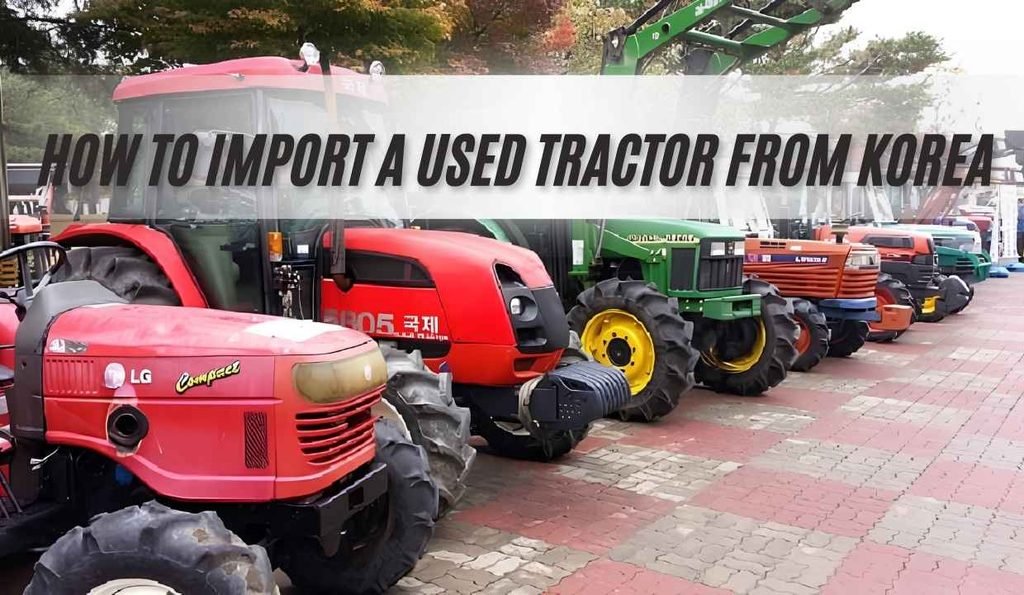
How to Import a Used Tractor from Korea: Step-by-Step Guide
Looking to import a Used Tractor for your farm from Korea, here we are with a simple step by step guide which will help you to get your used tractor from Korea.
South Korea has become a reliable source of used compact and mid-size tractors. Korean farms are small and intensively worked, but machines are usually serviced regularly, kept under cover, and replaced on a schedule, so many units reach the export market with moderate hours and good cosmetic condition. Buyers in Africa, Southeast Asia, South America, the Middle East, and Oceania increasingly turn to Korea for affordable, capable machines. This guide walks through the process from start to finish.
Define Your Requirements
Before contacting any seller, settle the basics:
Horsepower: Korean used stock is strongest in the 20-100 HP range, ideal for small and medium farms, orchards, and utility work.
Drive and configuration: 2WD vs 4WD, cab vs open platform, and tire type (agricultural lugs, turf, or industrial).
Implements: Loaders, rotary tillers, and backhoes are commonly sold with the tractor.
Local compatibility: Check your country’s rules on engine emissions, age limits, and PTO or hitch standards.
Know the Main Korean Brands
Kioti (Daedong): Korea’s best-known brand globally, popular for compact and utility tractors with strong parts availability.
TYM (Tong Yang Moolsan): Reliable mid-size tractors, widely exported, with a growing dealer network.
LS Tractor (LS Mtron): Robust machines from compact to high-horsepower models, with a strong presence in North America.
Asia Tractor and Kukje: Smaller or regional brands that appear in the used market, often at lower prices but with thinner parts support.
Japanese brands such as Yanmar, Kubota, and Iseki are also commonly sold through Korean exporters, since many were used locally.
Find a Reputable Exporter
Most buyers purchase through export dealers rather than from farmers directly. Common channels include online marketplaces such as Autowini, TradeKorea, and Korean machinery export platforms, as well as established Busan- and Incheon-based exporters. Look for:
A registered business (ask for the business registration number)
Verifiable export history and customer references
Clear photos and videos, including hour meter, engine bay, and serial plates
Willingness to allow third-party inspection
Be cautious about prices far below market, sellers who refuse video calls, and requests for full payment to personal accounts.
Inspect the Tractor
Remote buying is routine, but do not skip due diligence. Hire an independent inspector in Korea (several inspection companies serve foreign buyers) or request a live video walkaround. Check:
Hour meter against service records (meter tampering is a known risk)
Engine start-up, smoke, leaks, and unusual noise
Hydraulics, PTO, transmission shifting, and clutch
Tire and track wear, rust, and frame or axle cracks
Matching serial and engine numbers against documents
Understand the Costs
Prices vary by brand, age, hours, and market conditions, so treat these figures as indicative ranges and confirm with quotes:
Tractor price (FOB Korea): Roughly USD 3,000-15,000 for compact units, and USD 15,000-40,000 or more for larger, low-hour machines.
Inland transport and port handling in Korea: Typically USD 200-800.
Ocean freight: Around USD 1,500-4,500 for a 20-foot container, depending on destination and season. RoRo (roll-on/roll-off) or breakbulk shipping may be cheaper for larger machines but is less available.
Marine insurance: About 0.3-1% of cargo value. Do not skip it.
Import duty and taxes: These vary widely, from 0% to over 25% of CIF value, plus VAT or GST. Some countries give agricultural machinery concessions, while others charge extra on used goods.
Destination charges: Port fees, customs clearance, inland delivery, and broker fees can add USD 500-2,000.
Always compare quotes on the same trade term. FOB (Free on Board) leaves shipping to you, while CIF (Cost, Insurance, Freight) includes shipping to your port.
Prepare the Documentation
Exact requirements depend on your country, but you will typically need:
Commercial invoice and packing list
Bill of lading (or airway bill) from the shipping line
Proof of ownership or sales record from the seller, plus any Korean export declaration
Export declaration/clearance issued through Korea Customs Service, handled by the exporter or forwarder
Certificate of origin, which may reduce duties under a free trade agreement
Pre-shipment inspection certificate, mandatory in some countries
Cleaning/fumigation certificate: Biosecurity authorities in places like Australia and New Zealand require machinery to be free of soil, seeds, and plant material, and they inspect strictly.
Import permit or license and compliance documents, such as emission or safety certification where required
Check your customs authority’s rules before paying a deposit. Some countries ban used machinery over a certain age or require conformity checks. In the EU, for example, machinery must meet CE and emissions requirements, and the US may require EPA engine compliance paperwork.
Arrange Payment Safely
Common methods include telegraphic transfer (T/T), usually with a deposit and balance against shipping documents, and a letter of credit (L/C) for larger orders. Escrow services add protection for first-time buyers. Pay only to the company’s verified business account, and get a signed sales contract that lists the serial number, condition, price, and delivery terms.
Shipping and Logistics
Your options are:
Container shipping: Safer for weather and theft, but compact tractors may need to be partially dismantled (removing the roll bar, for example) to fit.
RoRo or breakbulk: Good for larger machines, with generally lower cost but fewer sailing schedules.
Most tractors ship from Busan or Incheon. Have the exporter or a freight forwarder secure the machine with blocking and bracing, photograph the loading, and send tracking details. Transit time to most destinations is 2-8 weeks.
Clear Customs and Take Delivery
On arrival, your clearing agent will submit the documents, pay duties and taxes, and arrange inspection. Quarantine checks can cause delays if the machine is dirty. Before accepting delivery, inspect for transit damage and file any insurance claim immediately.
Register and Service
Register the tractor if your country requires it, then service it right away: replace oil, filters, and fluids, and check belts, hoses, and batteries. Ask the seller for spare filters and a parts list for your model, and confirm local parts availability before buying.
Key Tips
Buy from sellers with verifiable track records.
Pay for independent inspection on higher-value purchases.
Budget 20-40% on top of the tractor price for freight, duties, and fees.
Confirm import rules before you commit.
Choose brands with strong parts support in your region.
Importing a used tractor from Korea can deliver excellent value, but only if you plan the paperwork, costs, and compliance carefully. With the right exporter and good due diligence, you can bring home a reliable machine for a fraction of the new price.